Cat Dander vs. Cat Hair: What Actually Triggers Your Allergy?
Cat hair is not the real allergen. Learn how dander, saliva and skin oils carry Fel d 1, and what that means for cleaning and filtration.
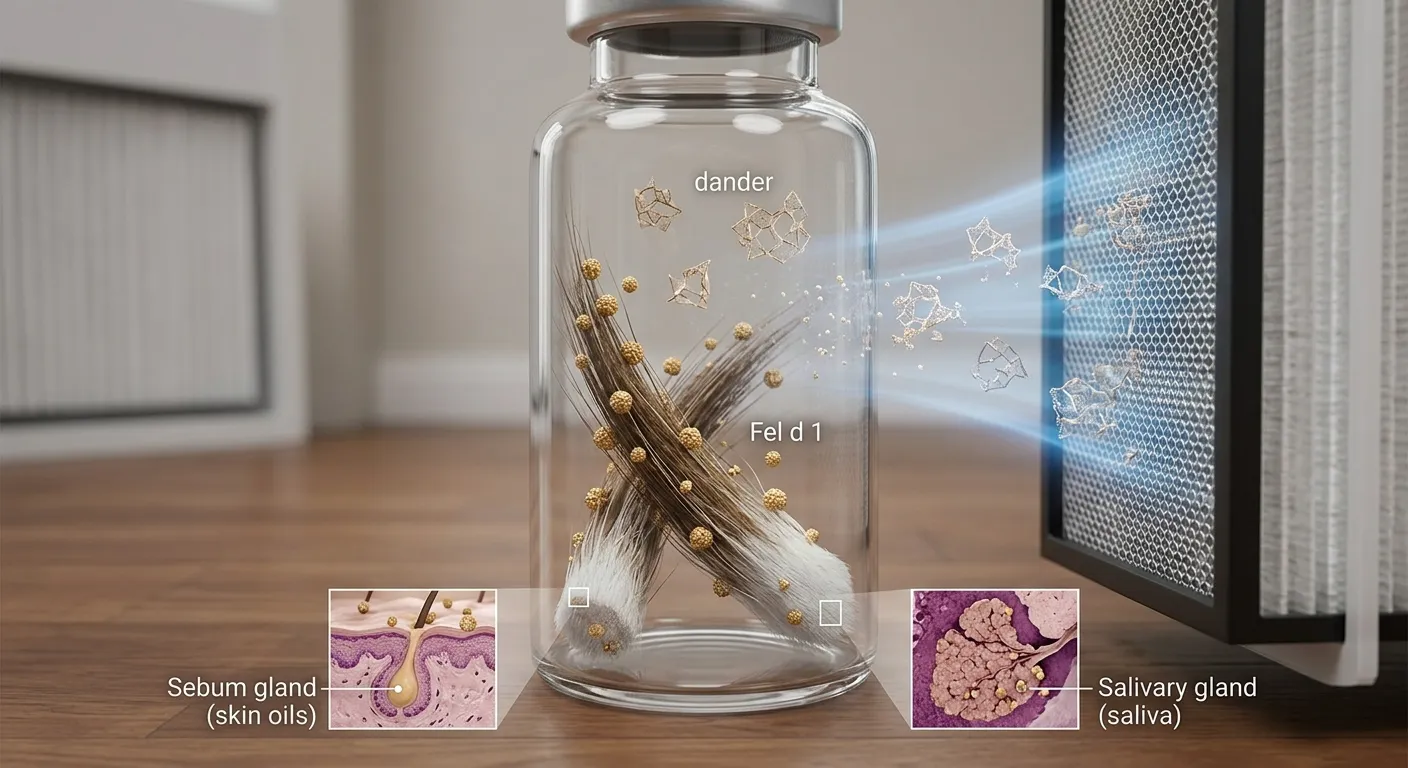
If you are researching the difference in a cat dander vs cat hair allergy, the short answer is that cat hair is not an allergen at all; it merely acts as a physical vehicle. True feline allergies are triggered by microscopic proteins—primarily Fel d 1—secreted in a cat's saliva, skin glands, and tears, which attach to shed hair and dead skin flakes (dander). Understanding this distinction fundamentally changes how you clean, filter your air, and manage your living space.
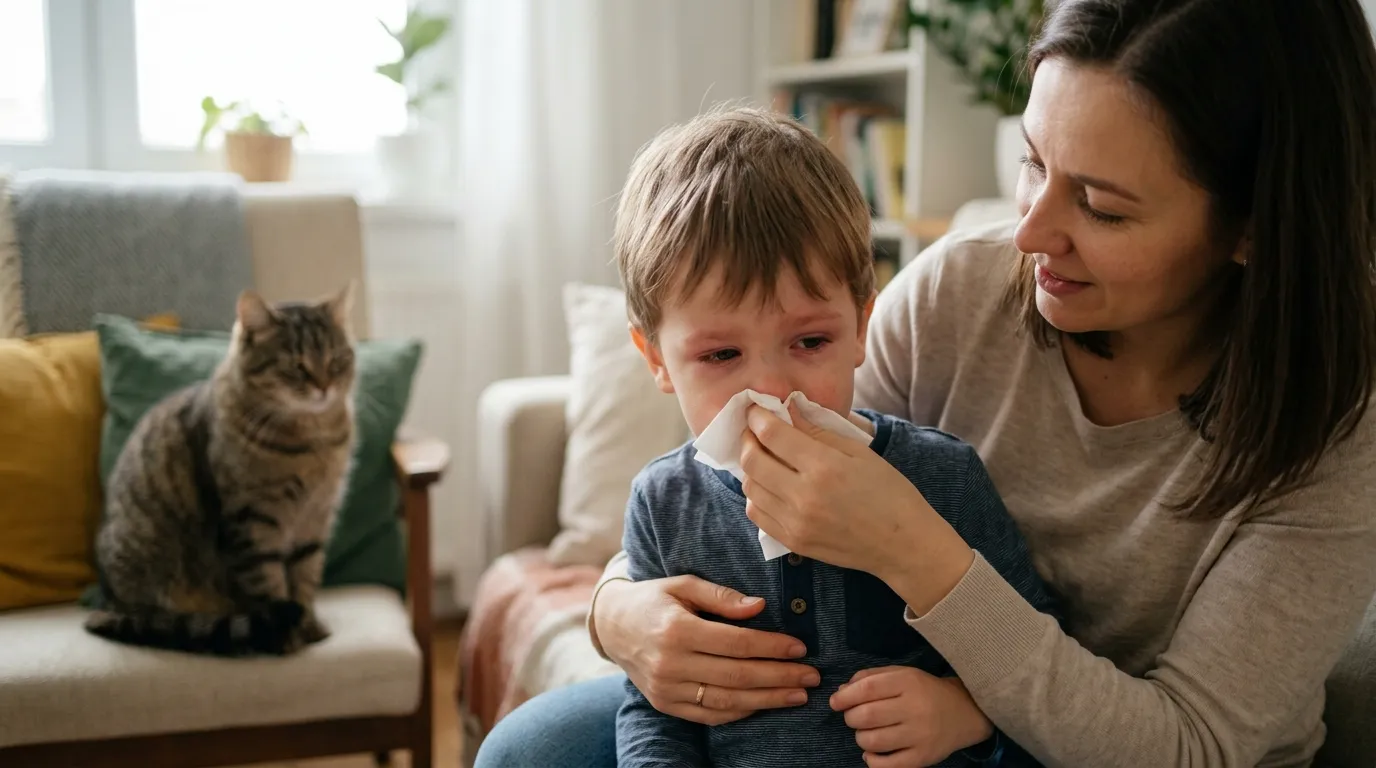
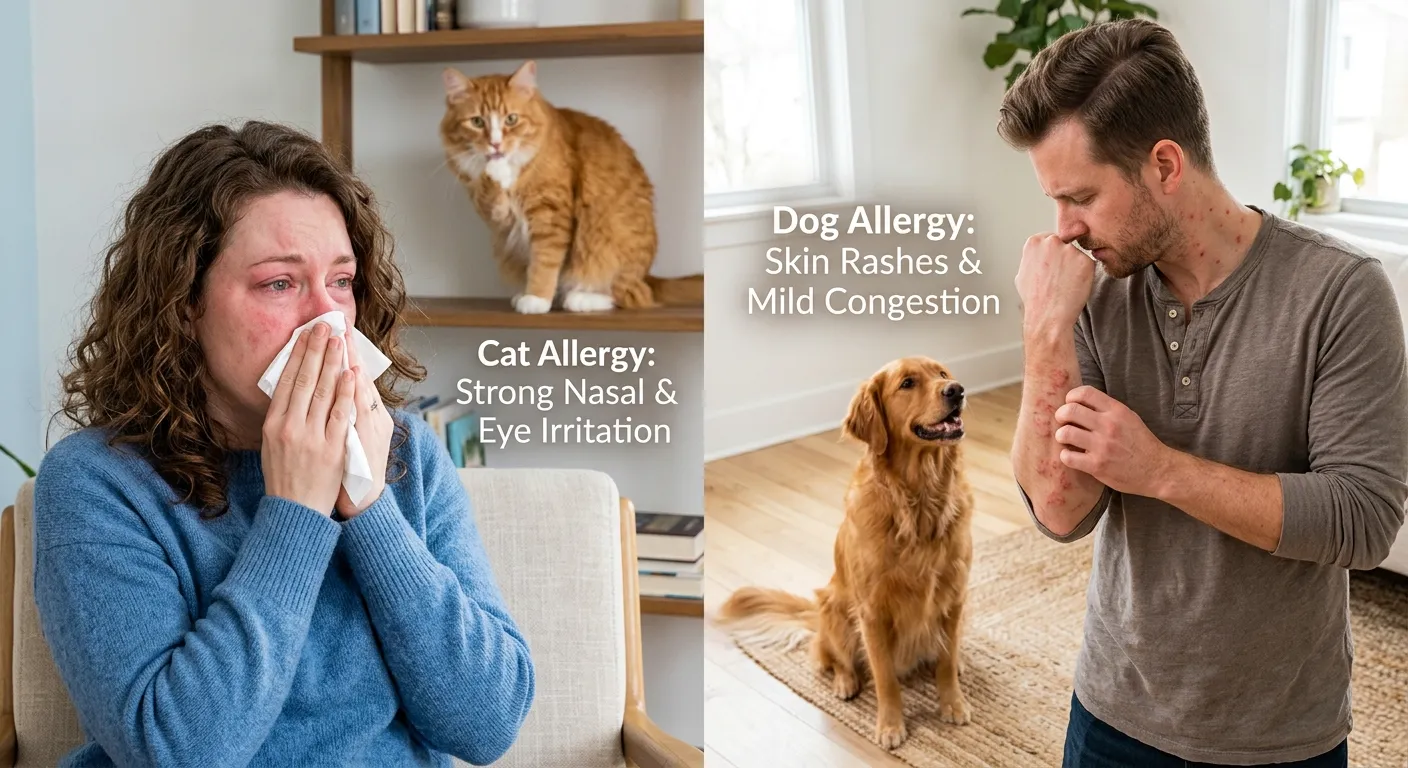
For decades, the common assumption has been that people who sneeze around cats are "allergic to cat fur." This belief leads many allergy sufferers to adopt short-haired or hairless breeds, expecting complete relief, only to discover their coughing, itchy eyes, and nasal congestion persist.
In this comprehensive guide, we examine the biological differences between feline hair and dander, explain how microscopic allergens become airborne and settle indoors, explore why hairless breeds still provoke immune reactions, and provide evidence-based cleaning protocols to protect your home.
Quick Summary: Hair vs. Dander at a Glance
| Factor | Cat Hair | Cat Dander |
|---|---|---|
| Biological Material | Keratin protein strands produced in hair follicles | Desquamated microscopic epithelial (dead skin) cells |
| Allergenic Status | Non-allergenic (inert vehicle) | Highly allergenic (impregnated with Fel d 1) |
| Particle Size | Visible to the naked eye (millimeters to centimeters) | Microscopic (typically 2 to 10 microns in diameter) |
| Aerodynamic Behavior | Falls quickly to floors and furniture | Floats suspended in stagnant air currents for hours |
| Primary Removal Method | Standard sweeping, lint rollers, mechanical brushes | Sealed True HEPA filtration and wet extraction |
Where Cat Allergens Come From: The Biology of Fel d 1
To understand why hair is merely an innocent bystander, you must examine the source of feline allergen synthesis.
As established in our medical guide on what causes cat allergies, human immune responses to felines are driven primarily by Fel d 1, a 35 kDa tetrameric secretoglobin glycoprotein. Fel d 1 accounts for up to 95% of human feline allergic reactions.
Cats produce Fel d 1 predominantly in three anatomical sites:
- Salivary Glands: High concentrations of active Fel d 1 are secreted continuously in feline saliva.
- Sebaceous (Skin) Glands: Microscopic glands at the base of every hair follicle secrete Fel d 1 alongside natural skin oils (sebum).
- Lacrimal and Perianal Glands: Tears and anal secretions contain secondary concentrations of the protein.
+--------------------------------------------------------------------------+
|                  THE ALLERGEN DISTRIBUTION CYCLE                         |
|                                                                          |
|  [Saliva & Sebaceous Glands]  -->  Synthesizes active Fel d 1 protein     |
|             │                                                            |
|             ▼                                                            |
|     [Daily Grooming]          -->  Coats fur and skin in wet protein     |
|             │                                                            |
|             ▼                                                            |
|     [Drying & Flaking]        -->  Saliva dries; dead skin sloughs off   |
|             │                                                            |
|             ▼                                                            |
|     [Airborne Dispersion]     -->  Microscopic dander (2–10 μm) floats   |
+--------------------------------------------------------------------------+
When a cat grooms itself, it acts like an allergen paintbrush. During daily grooming, the cat coats its entire body in saliva. As the saliva dries on the hair shafts and outer epidermis, the active Fel d 1 crystallizes and bonds tightly to loose hairs and sloughing microscopic skin cells.
What Is Cat Dander? Particle Size and Aerodynamic Behavior
While hair is large and heavy enough to fall straight to the floor, dander behaves in an entirely different physical realm.
All mammals undergo continuous epidermal turnover: old, dead skin cells detach and slough off to make way for new skin cells. In cats, these microscopic dead skin flakes are known as dander.
Why Dander Is Aerodynamically Unique
- Microscopic Particle Dimensions: Individual feline dander particles typically measure between 2 and 10 microns in diameter, with fine particles under 5 microns remaining airborne indefinitely in stagnant indoor air currents. For comparison, a human hair is roughly 70 microns thick.
- Deep Pulmonary Penetration: Because sub-5-micron particles are so tiny, they completely bypass the ciliated mucus filters in human nasal passages. When inhaled, these fine dander particles penetrate deep into the lower pulmonary bronchioles, triggering acute asthmatic spasms, coughing, and wheezing.
- Extreme Surface Adhesion: Secretoglobins possess a high surface-binding affinity (stickiness). Microscopic dander flakes cling tenaciously to smooth drywall, clothing, wooden furniture, and deep carpet fibers.
- Environmental Persistence: Because dander binds tightly to indoor textiles and resists natural degradation, allergen deposits in vacated homes can persist for up to 20 to 24 weeks (up to 6 months) post-feline habitation unless neutralized through wet extraction and sealed HEPA filtration.
Why Short-Haired and Hairless Cats Still Trigger Symptoms
Understanding that dander—not hair—is the true carrier explains why adopting a short-haired or hairless cat rarely solves allergy problems.
Short-Haired Cats
A short-haired cat possesses just as many epidermal skin cells and sebaceous glands as a long-haired cat. While a short-haired cat produces less visible shed fur on your sofa, its skin secretes identical amounts of Fel d 1, and its daily grooming spreads identical amounts of saliva across its coat.
Hairless Cats (The Sphynx)
Hairless breeds like the Sphynx are frequently marketed as the ultimate hypoallergenic pets. However:
- No Fur to Absorb Sebum: In coated cats, fur absorbs a portion of the natural oils secreted by sebaceous glands. In hairless cats, oily sebum accumulates directly on the skin surface.
- Direct Allergen Transfer: Because the skin is exposed, petting a Sphynx transfers concentrated salivary and sebaceous Fel d 1 directly onto your hands and clothes.
- Dander Still Sloughs: Hairless cats still shed dead skin cells. While they do not shed hair, microscopic flakes of allergen-coated skin still detach into the air.
What This Means for Vacuuming, Bedding, and Air Filtration
Because cat allergens are microscopic, sticky, and buoyant, standard household cleaning habits often make allergy symptoms worse rather than better.
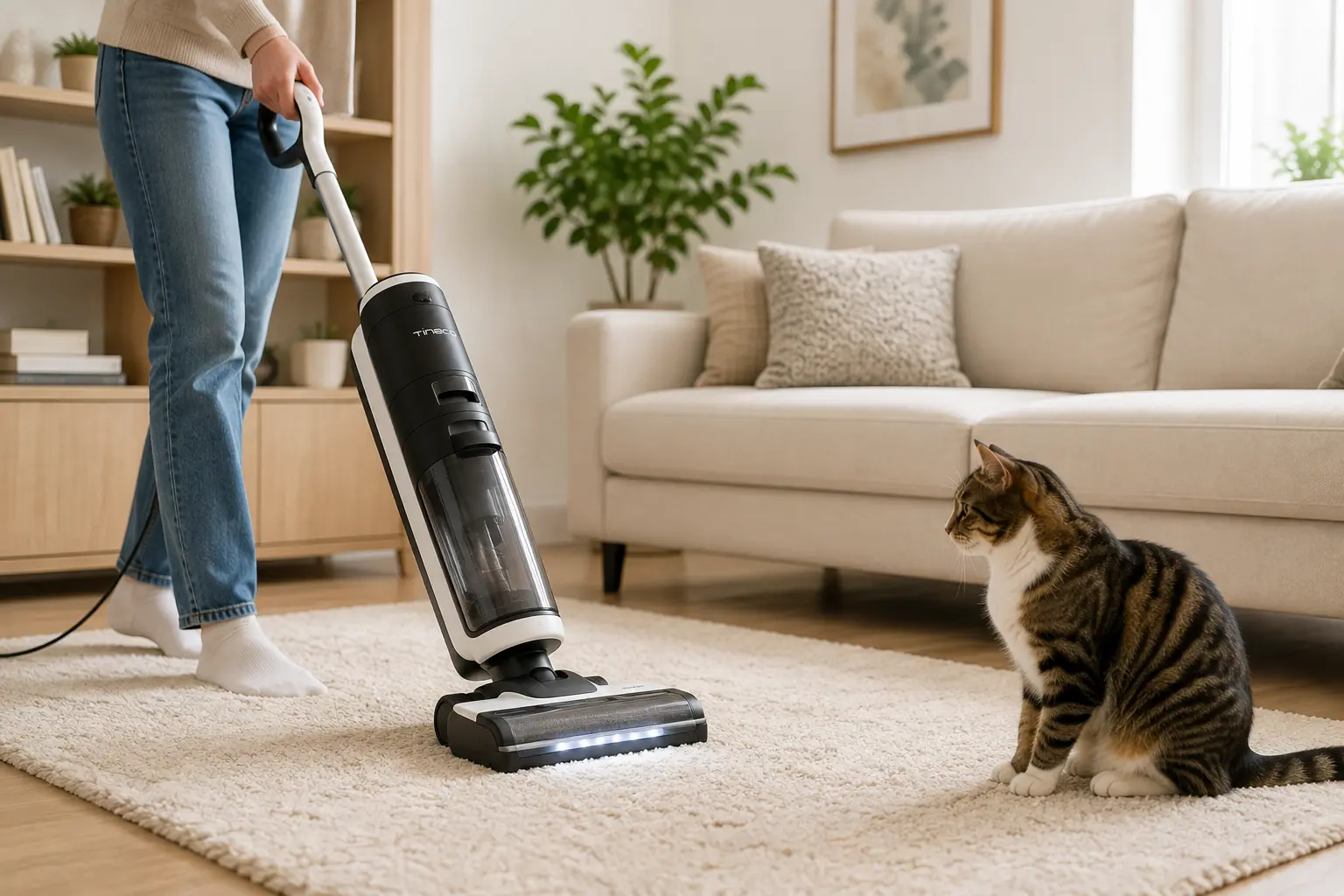
1. The Vacuuming Dilemma: Why Sealed HEPA Is Mandatory
Standard household vacuums without sealed filtration systems act like allergen leaf blowers. When you vacuum a rug, the brush roll agitates settled dander, sucking it into the canister. If the vacuum lacks a sealed True HEPA exhaust system, microscopic particles between 2 and 10 microns pass straight through the porous bag or motor filter, spraying an invisible aerosol of concentrated allergens into your breathing space.
- Demand Sealed True HEPA: A sealed True HEPA vacuum captures at least 99.97% of particles down to 0.3 microns. Explore our top tested models in our guide to the best HEPA vacuum for pet hair.
- Wear Protection: If you are allergic, wear an N95 respirator while vacuuming and leave the room for 30 minutes after cleaning.
2. High-Efficiency Air Filtration
Because fine dander particles linger in the air for hours, running a True HEPA air purifier in high-traffic rooms continuously scrubs floating dander before it settles onto furniture. Compare top bedroom units in our guide to the best air purifiers for cat allergies.
3. Bedding Laundering Standards
Because you spend 7 to 8 hours each night with your face pressed against pillows, bedding is the most vulnerable dander reservoir in the home.
- Wash all exterior sheets, pillowcases, and blankets weekly in water heated to at least 130°F (54°C) or higher. Sustained temperatures of 130°F or higher denature secretoglobin protein bonds and dissolve water-soluble Fel d 1 from textile fibers.
- Encase mattresses and pillows in zippered allergen-barrier protectors to seal legacy dander inside the mattress foam.
What Helps vs. What Does Not: A Practical Guide
Navigating cat allergy management requires focusing your time and money on interventions that target microscopic dander rather than just loose hair.
+--------------------------------------------------------------------------+
|                  EFFECTIVE VS. INEFFECTIVE ALLERGY ACTIONS               |
|                                                                          |
|  [DOES NOT WORK]                                                         |
|  - Shaving your cat (dander and saliva remain identical)                 |
|  - Dry sweeping or feather dusting (aerosolizes settled dander)          |
|  - Air ionizers (generate lung-irritating ozone)                         |
|                                                                          |
|  [HIGHLY EFFECTIVE]                                                      |
|  - Running continuous True HEPA air purifiers (captures sub-5 μm dander) |
|  - Allergen-reducing diets (Purina LiveClear lowers active Fel d 1)      |
|  - Keeping the bedroom strictly pet-free 24/7                            |
|  - Damp microfiber dusting and hot water laundry (>=130°F)               |
+--------------------------------------------------------------------------+
Ineffective Strategies
- Shaving Your Cat: Shaving a cat does not reduce Fel d 1 production. The cat still grooms its stubble, and its skin still sheds dander. Shaving can also stress the cat and cause skin irritation.
- Dry Dusting: Feather dusters and dry cloths merely flick settled dander into the air, keeping allergens suspended for hours.
- Routine Water Bathing: Bathing a cat frequently dries out its skin, causing increased flaking and higher dander output, while allergen levels rebound within 48 hours.
Effective Strategies
- Allergen-Reducing Diets: Feeding an anti-Fel d 1 egg IgY diet (such as Purina Pro Plan LiveClear) reduces active allergen on hair and dander by an average of 47% starting by the third week of daily feeding.
- Damp Wiping: Wipe down hard surfaces and pet fur with a damp microfiber cloth to trap dander without launching it into the air.
- Comprehensive Home Protocols: Follow our master blueprint on how to reduce cat allergens at home and learn to recognize early cat allergy symptoms before they progress to chronic airway inflammation.
Key Takeaways
- Hair Is an Inert Carrier: Cat hair itself is not an allergen; it simply carries dried saliva and skin flakes impregnated with the Fel d 1 protein.
- Dander Is Microscopic and Buoyant: Feline dander particles measure 2 to 10 microns in diameter, with sub-5-micron particles floating in household air for hours and penetrating deep into the lungs.
- Hairless Cats Still Produce Dander: Hairless breeds like the Sphynx still produce saliva and slough dead skin cells; their exposed skin accumulates concentrated allergen-rich sebum.
- Standard Vacuums Worsen Exposure: Standard vacuums blow microscopic dander back into the air; only sealed True HEPA vacuums reliably trap particles down to 0.3 microns.
- Target Environmental Reservoirs: Focus your defense on True HEPA air filtration, weekly high-heat laundering (≥130°F / 54°C), and keeping the bedroom permanently off-limits.
Sources
- Bonnet, B., et al. (2018). "An update on molecular cat allergens: Fel d 1 and beyond." Allergy, Asthma & Clinical Immunology, 14, 7.
- Custovic, A., et al. (1998). "Distribution and aerodynamic characteristics of cat allergen Fel d 1 in homes." Journal of Allergy and Clinical Immunology, 102(4), 607–612.
- Luczynska, C. M., et al. (1990). "Airborne concentrations and particle size distribution of allergen Fel d 1 in homes with cats." American Review of Respiratory Disease, 141(2), 361–367.
- American Academy of Allergy, Asthma & Immunology (AAAAI). "Pet Allergens and Asthma: Particle Dynamics and Environmental Mitigation."
- Satyaraj, E., et al. (2019). "Anti-Fel d 1 immunoglobulins reduce active allergen in cat saliva and dander." Journal of Feline Medicine and Surgery, 21(10), 958–965.